What Is Sand Casting?
Sand casting is one of the most established metal forming processes and remains a practical solution for producing metal components with flexible geometry, broad material compatibility, and controlled tooling cost.
It is widely used across industrial, automotive, energy, and machinery sectors.
Typical workflow:
Pattern preparation (wood, metal, or resin)
Sand mold forming and compaction
Mold assembly and gating setup
Metal pouring
Solidification and cooling
Shakeout, cleaning, and finishing
Because molds are destroyed after each pour, sand casting allows high design freedom without permanent tooling constraints.
Cast iron (gray iron, ductile iron)
Carbon steel and low-alloy steel
Stainless steel
Aluminum alloys
Copper-based alloys (bronze, brass)
Strengths of Sand Casting
Low tooling cost compared to permanent molds
Scalable part size, including very large components
Broad alloy compatibility
Flexible design iteration, suitable for early-stage development
·Machine bases and frames ·Pump and valve bodies ·Engine blocks and housings
·Gearbox casings ·Heavy structural components ·Energy and infrastructure part














Materials Compatibility:




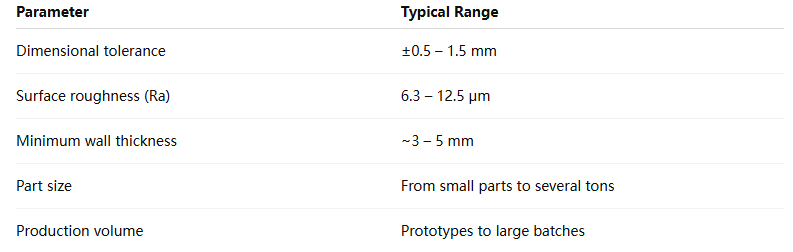
Typical Capabilities:
Common Applications: