For paint and powder coating, deposited material takes up space on the surfaces it covers.
Look beyond the visible exterior
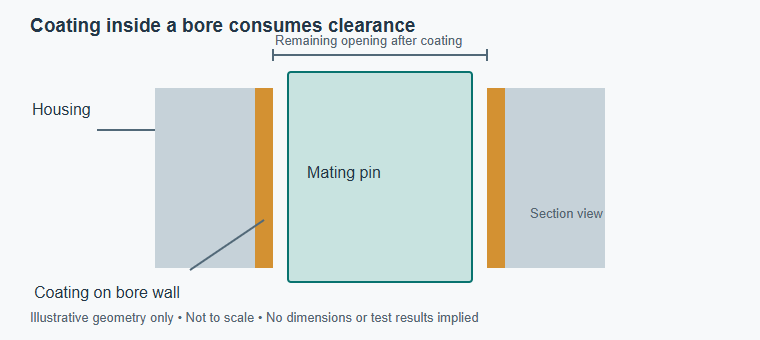
Consider an illustrative painted enclosure with a locating bore, threaded fasteners and a close-fitting cover. It is a design example, not a customer case.
Coating inside the bore reduces its available opening. Coating on a locating boss increases its outside size. If both mating surfaces are coated, both layers consume clearance. Coating buildup on threads can also affect engagement; forcing the fastener may damage the finish or the thread.
An overall note such as “powder coat black” does not tell the finisher how to handle these interfaces.
Give each functional surface a finishing decision
Mask surfaces that need to remain uncoated. Identify the bore, thread or locating face and the intended masking boundary. “Keep holes clear” is ambiguous if some holes need coating for corrosion protection and others need an uncoated fit.
Allow for coating where protection must remain continuous. Agree the coating system and thickness range, then assess clearance at the finished condition. Increasing clearance must not compromise location or support.
Review finishing and machining order. Machining a critical surface after coating can recover a dimension, but exposes substrate and may damage adjacent coating. It needs an agreed protection plan rather than becoming an improvised repair.
Electrical grounding points may also need a defined conductive contact area. Masking them requires consideration of both conductivity and corrosion protection.
Inspect the condition the customer will assemble
The drawing should make clear whether a critical requirement applies before or after finishing. For a close fit, checking a bare component alone is insufficient; use the finished mating parts or an agreed functional gauge where appropriate.
Mark the surfaces that locate, fasten or seal, and send them to Qualix. We can help coordinate machining and finishing around those interfaces—even if the rest of the drawing is still being developed.