Machining may expose a problem that was already inside the casting.
A hidden void is not always a leak path
Consider an illustrative cast pump cover with a machined sealing face and fluid passage. This is an engineering example, not a reported customer failure.
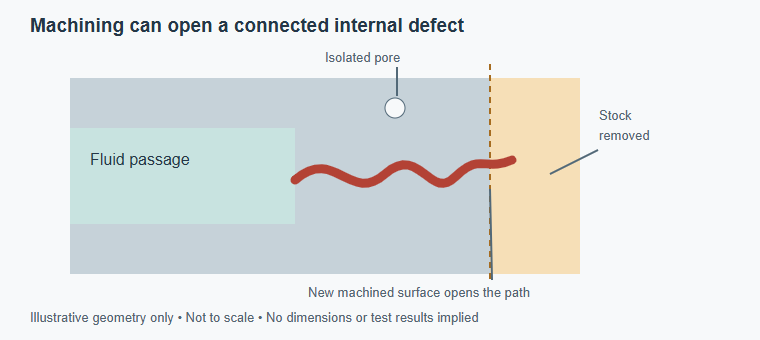
Gas pores or shrinkage cavities may lie beneath the original surface. Removing material can open them to a passage or exterior. Leakage occurs when defects form a connected path between regions under different pressures; an isolated pore does not necessarily leak.
But porosity is not the only suspect. A crack, an unsuitable sealing-face condition, an incorrect gasket or the test fixture itself can produce a similar symptom. Finding where the fluid or gas escapes is more useful than immediately ordering a finer surface finish.
Choose the response after locating the path
If leakage follows the joint, review the sealing surface, gasket support and assembly conditions. Surface roughness alone does not describe flatness or how a joint is loaded.
If leakage passes through the casting wall, review the defect location with the foundry: local section changes, feeding or filling conditions, and machining stock may need attention. Switching casting processes without that diagnosis may leave the underlying issue unresolved.
Vacuum impregnation can seal suitable connected porosity when the application permits it. It is not a structural repair for cracks or large defects. Any proposed treatment needs customer approval, compatibility review and verification against the agreed leak requirement.
Specify a test that represents the finished component
“Leak-free” needs a practical definition: test medium, pressure differential, duration and an acceptance criterion appropriate to the application. These can be developed together rather than guessed from a generic casting specification.
Where machining can open a leak path, an as-cast test alone is insufficient. Include verification after the relevant machining and any approved sealing treatment.
Send Qualix a sketch showing the fluid space, the suspected leak location and how the component operates. That gives us a useful starting point for coordinating the casting, machining and test plan.